Details & Abstract
A talk by Koushik Dutta exploring the evolution of the universe, from General Relativity and cosmic expansion to inflation, dark matter, and modern cosmological puzzles. The session concluded with a reflection on humanity’s place in the cosmos—insignificant in scale, yet significant enough to understand it.
What Happened
The talk Insignificant, but Significant Enough, delivered by Koushik Dutta, provided a broad and insightful overview of modern cosmology, tracing humanity’s understanding of the universe from the foundations of general relativity to contemporary challenges in cosmological research. Beginning with the ideas of curved spacetime and gravity as described by Einstein’s theory, Prof. Dutta introduced the audience to the large-scale structure and evolution of the universe through the framework of the expanding Friedmann–Robertson–Walker (FRW) universe. He explained how observations of cosmic expansion, the cosmic microwave background, and the matter-energy composition of the universe shape our present understanding of cosmology.
A significant portion of the lecture focused on the conceptual and observational puzzles of modern cosmology, including the flatness problem, horizon problem, dark matter, dark energy, and the theory of cosmic inflation. Prof. Dutta discussed how inflation provides a compelling explanation for the remarkable homogeneity of the observable universe and the origin of primordial fluctuations that later gave rise to cosmic structures. The session also touched upon current frontiers in cosmology, including density perturbations, gravitational waves originating from the early universe, and ongoing tensions in cosmological observations such as measurements of the expansion rate of the universe.
Beyond scientific discussions, the talk carried a philosophical undertone, emphasizing humanity’s place in an unimaginably vast cosmos. Through reflections on astronomical timescales, cosmic evolution, and striking visual examples such as the Crab Nebula, Prof. Dutta highlighted how humans may appear insignificant in the scale of the universe, yet remain “significant enough” to seek and understand its underlying laws. The lecture concluded on an inspiring note, encouraging appreciation for scientific inquiry as one of humanity’s greatest collective endeavors.
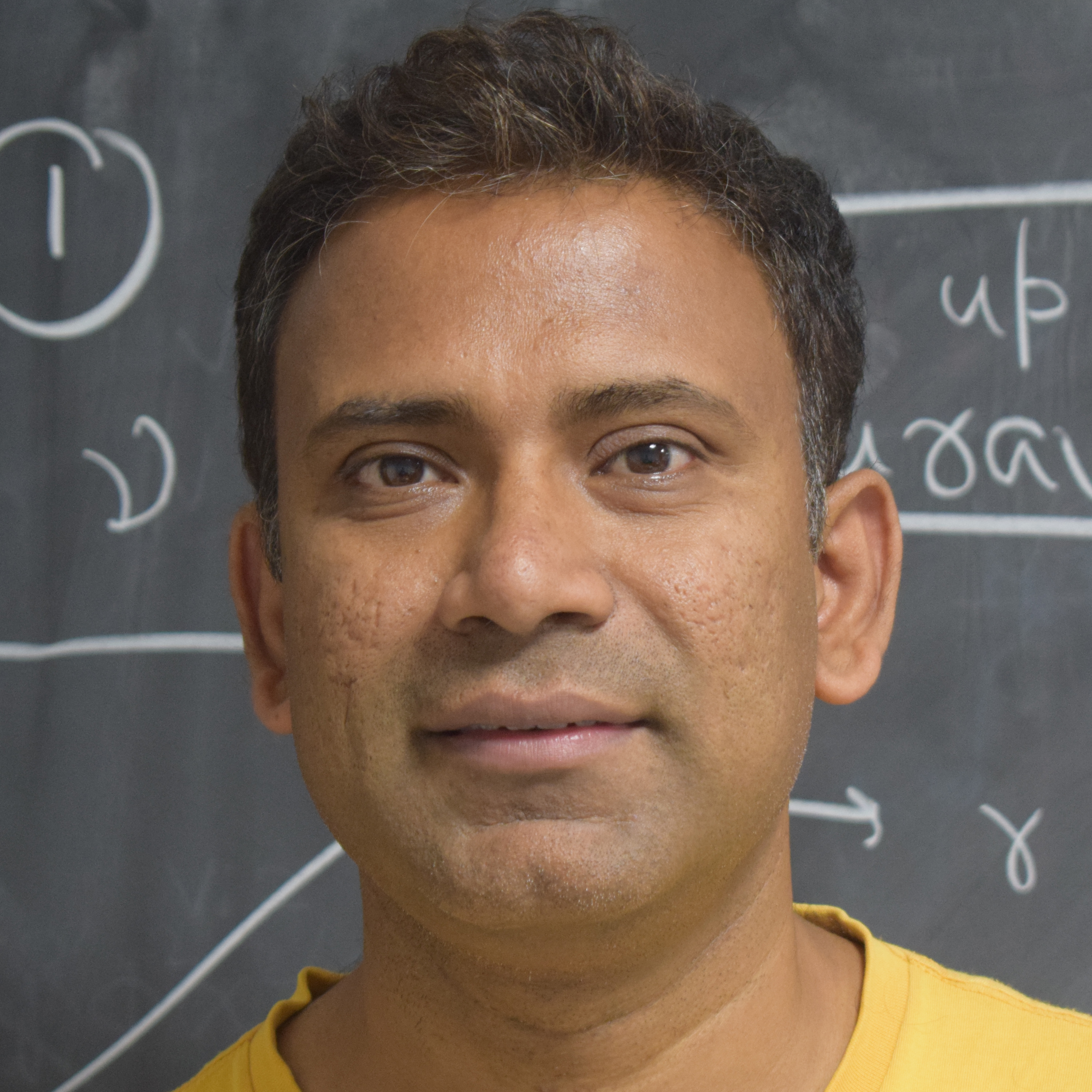
Speaker / Author
Currently, he is a Associate Professor at the Department of Physical Sciences at the Indian Institute of Science Education and Research, Kolkata.
By profession, he studies physics and wonders he has been still paid for it :-) Physics allows him to ask a few simple questions, and look for some possible solutions even if they usually turn out to be wrong ;-)