Crystals and Broken Symmetry
To understand time crystals, we first need to examine regular crystals. In a glass of water, the molecules are randomly arranged, demonstrating translational symmetry; every part looks the same. In contrast, crystals have atoms in specific positions, creating a repeating pattern that breaks this symmetry. This phenomenon, known as spontaneous symmetry breaking, is crucial in modern physics. Scientists categorise phases of matter by the types of symmetries they break. Regular crystals break spatial symmetry, leading to the intriguing question: If matter can form repeating patterns in space, can it form repeating patterns in time?
An Idea That Seemed Impossible
In 2012, physicist Frank Wilczek, who won a Nobel Prize for his work, introduced an intriguing idea that prompted a lot of discussion. He suggested that certain quantum systems might have the ability to organise themselves into structures that repeat over time, similar to how traditional crystals repeat in space. This notion was significant because it challenged the widely held belief that systems in their lowest-energy state, known as the ground state, should remain static. Wilczek proposed that a quantum system could maintain a perpetual state without energy input, leading to the concept of a time crystal, an unusual structure exhibiting order in the dimension of time rather than physical space. This idea intrigued many scientists while also attracting criticism, prompting discussions in the field of physics.
The No-Go Theorems
After Wilczek put forward his intriguing proposal, scientists took a closer look to see if such systems could actually be found in nature. Multiple research teams discovered that, under typical conditions, a system in thermal equilibrium simply can't exhibit the kind of perpetual motion that Wilczek originally suggested. These findings became known as no-go theorems, effectively pushing the idea of equilibrium time crystals to the sidelines. For a brief moment, it seemed like the concept had hit a dead end. However, as often happens in science, progress isn't always linear. While the initial proposal didn't pan out, the ongoing discussions opened up an unexpected avenue of exploration. The focus shifted from asking, "Can time crystals exist in equilibrium?" to a more intriguing question: "Can they exist outside of equilibrium?" As it turns out, the answer is a resounding yes.
Discrete Time Crystals
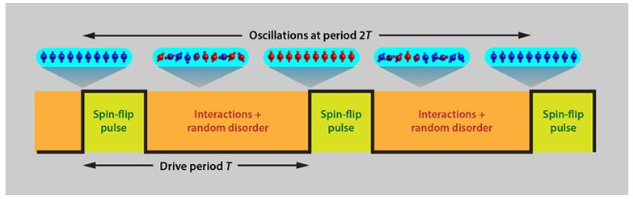
Researchers have made an intriguing discovery about certain quantum systems that are periodically driven. Picture this: when you apply a pulse to a system every second, you might expect it to respond in sync, following that same one-second rhythm. However, some interacting quantum systems show fascinating behaviour. Instead of following the one-second pulse, they actually respond every two seconds. This means that if the driving force operates on a regular cycle (T), the system starts to develop a new period that's twice as long (2T). This phenomenon, known as a subharmonic response, occurs when particles interact in a way that creates a longer period not dictated by external forces. This behaviour defies the time-translation symmetry of driving pulses, similar to how regular crystals disrupt spatial symmetry. Such systems are called discrete time crystals, providing intriguing insights into quantum behaviour.
Why This Is Different from a Clock
At first glance, you might think a time crystal is just like an ordinary clock, given that both show periodic behaviour. However, there's a key difference in how they achieve that rhythm. A clock is built with mechanisms that are specifically designed to tick at a certain frequency. Its rhythm is carefully engineered into its structure. In contrast, time crystals create their own rhythm. While there's an external influence driving them, the system doesn't just copy that input. Instead, the particles in a time crystal come together to find their own collective rhythm, which is different from the outside force they're responding to. This means that the oscillation in time crystals isn't just a product of design; rather, it's an inherent property of the state of matter itself. This unique characteristic is what sets time crystals apart from simple oscillators and qualifies them to be considered true phases of matter.
Experimental Confirmation
For a long time, time crystals were just an intriguing idea floating around in theoretical physics. Everything changed in 2017 when two different research teams made a groundbreaking discovery by actually observing these unique structures in the lab. One group worked with chains of trapped ions, while the other focused on special defects in diamonds called nitrogen vacancy centres. What's fascinating is that both teams, despite using completely different methods, observed similar behaviour: a consistent pattern of response that didn't quite match the rhythm of the forces acting on it. This was a game-changer! It showed that time crystals weren't just some mathematical fantasy; they were indeed real, physical entities. What once seemed like a far-fetched notion had finally turned into an exciting reality.
Why Physicists Care
Time crystals are intriguing because they reveal a new way to organise matter, moving beyond the traditional focus on stable systems. They exist in a non-equilibrium state, where constant forces and interactions lead to novel behaviours. This discovery enhances our understanding of symmetry breaking and quantum many-body physics, highlighting the complexity of nature. Time crystals remind us that even familiar concepts like crystals, symmetry, and time still hold endless mysteries to explore.
The Bigger Picture
The story of time crystals illustrates how scientific discovery unfolds through bold ideas that initially face doubts. Rather than discouraging research, criticism guided scientists to a deeper understanding of this remarkable breakthrough in condensed matter physics. Time crystals remind us that scientific progress often requires confronting tough questions. This journey transformed the seemingly impossible into reality, enhancing our understanding of physical laws and highlighting the importance of curiosity and critical thinking in the pursuit of knowledge.
Acknowledgement
AI tools, including ChatGPT (OpenAI), were used during the preparation of this article for brainstorming, improving clarity, and identifying relevant scientific literature.